
Hi! I’m Haitian Zhong (仲海天, aka JZSAWYER), a third-year Ph.D. student at the New Laboratory of Pattern Recognition (NLPR ), State Key Laboratory of Multimodal Artificial Intelligence Systems (MAIS
 ), Institute of Automation, Chinese Academy of Sciences (CASIA
 ), supervised by Prof. Tieniu Tan (谭铁牛), co-supervised by Prof. Qiang Liu (刘强). I am also a joint Ph.D. student at Beijing Zhongguancun Academy, advised by Prof. Bin Dong (董彬) and Prof. Wentao Zhang (张文涛). Previously, I was a research assistant at XYZ AI Lab and Microsoft Research Asia, working with Jiang Bian (边江) and Lei Song (宋磊).
I obtained my Bachelor’s degree in Mathematics and Applied Mathematics from Cuiying Honors College (China’s Top-notch Undergraduate training program 2.0), Lanzhou University
 . I was nominated as the Undergraduate Graduate Representative of Lanzhou University. During my undergraduate period, I won two Excellence Awards at 2022 S.-T. Yau College Student Mathematics Contest
 in the subjects of Analysis and Partial Differential Equations (分析与偏微分方程) and Applied and Computational Mathematics (应用与计算数学). This distinction made me the FIRST winner ever from Lanzhou University to be recognized in these two subjects.
My research focuses on LLM post-training and agentic RL, including reinforcement learning for multi-turn tool use, agent harnesses, and reasoning evaluation. I also work on knowledge editing and trustworthy AI. You can refer to my personal CV for more information.
Outside of research, I’m a big fan of Chelsea Football Club and the Los Angeles Lakers
 . My GOATs are Lionel Messi⚽ and LeBron James🏀 in their respective fields. In my free time, I enjoy running👟 and playing basketball🏀 a lot.
Feel free to reach out if you want to chat or collaborate (haitian DOT zhong AT cripac DOT ia DOT ac DOT cn)!
🔥 News
- 2026.09: 🔥 New preprint: More Programs or More Rolls? Separating Coverage from Specialization in LLM Harnesses, on agent harness evaluation.
- 2026.07: 🔥 MorphoBench: A Benchmark with Difficulty Adaptive to Model Reasoning published in Findings of ACL 2026! Joint work on adaptive evaluation of model reasoning.
- 2026.07: Released the team technical report AI4AI at Scale: A Full-Pipeline System for Enhancing LLM Agentic Capabilities, covering data, post-training, and runtime development for deep search agents.
- 2026.03: 🔥 Released SCAN: Sparse Circuit Anchor Interpretable Neuron for Lifelong Knowledge Editing, a circuit-based approach to sequential knowledge editing.
- 2026.02: 🔥 Released RC-GRPO: Reward-Conditioned Group Relative Policy Optimization for Multi-Turn Tool Calling Agents, on reward-conditioned exploration for agent post-training.
- 2025.08: 🔥🔥🔥 Paper REACT: Representation Extraction And Controllable Tuning to Overcome Overfitting in LLM Knowledge Editing accepted to The 2025 Conference on Empirical Methods in Natural Language Processing (EMNLP 2025)!
- 2024.09: 🔥🔥🔥 Paper VLKEB: A Large Vision-Language Model Knowledge Editing Benchmark accepted to The 38th Annual Conference on Neural Information Processing Systems (NeurIPS 2024)!
- 2022.07: 🎖️🎖️ Won two Excellence Awards at 2022 S.-T. Yau College Student Mathematics Contest. First candidate in the history of LZU.
💻 Internships
- 2025.03 - 2026.09, Research Assistant, XYZ AI Lab, Agentic RL Group, Beijing. (Mentors: Jiang Bian and Lei Song)
- Worked on multi-step search trajectory distillation and curation for SFT and GRPO experiments, including tool-call consistency, evidence checks, deduplication, and trace mixing.
- Developed agent harness and replay support for context compaction, tool-error recovery, and export of training examples aligned with the agent-visible context.
- 2025.10 - 2026.03, Research Assistant, Microsoft Research Asia, Machine Learning Group, Beijing. (Mentors: Jiang Bian and Lei Song)
- 2024.03 - 2024.06, Research Assistant, Microsoft Research Asia, Social Computing Group, Beijing. Worked on LLM safety with Xing Xie; received the Stars of Tomorrow award. Certificate
- 2023.10, Undergraduate Researcher, CRIPAC-DIG, Beijing. Worked on large vision-language model knowledge editing.
📝 Publications
† Equal contribution.
Post-training
Agent post-training, tool use, harnesses, and reasoning evaluation.
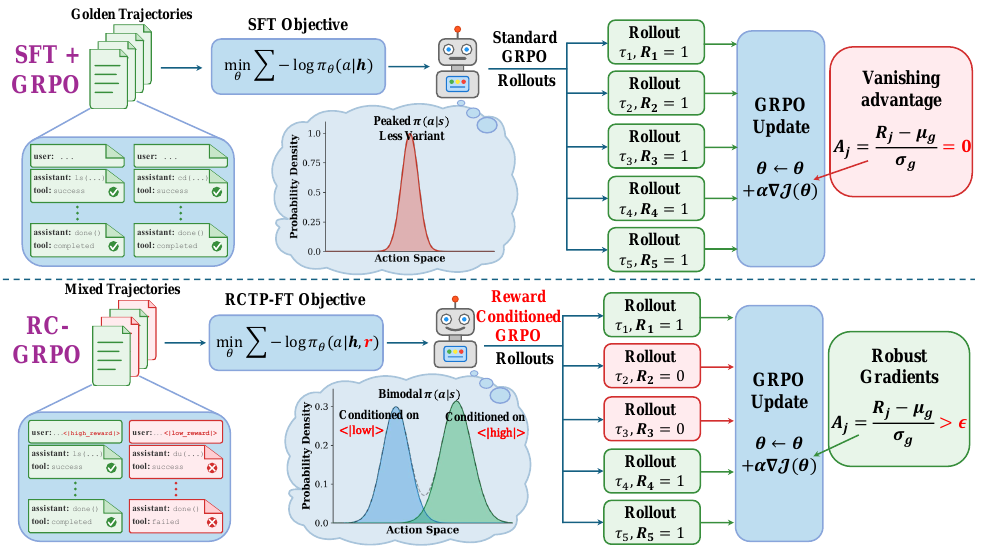
RC-GRPO: Reward-Conditioned Group Relative Policy Optimization for Multi-Turn Tool Calling Agents
Haitian Zhong, Jixiu Zhai, Lei Song, Jiang Bian, Qiang Liu, Tieniu Tan
- Abstract: Multi-turn tool-calling agents face sparse rewards, and GRPO updates can stall when rollouts within a group receive identical rewards. RC-GRPO first learns a reward-conditioned trajectory policy from mixed-quality examples, then varies reward tokens during RL to encourage informative exploration. We evaluate the approach on BFCLv4 multi-turn tool-calling tasks, studying both task performance and training dynamics.
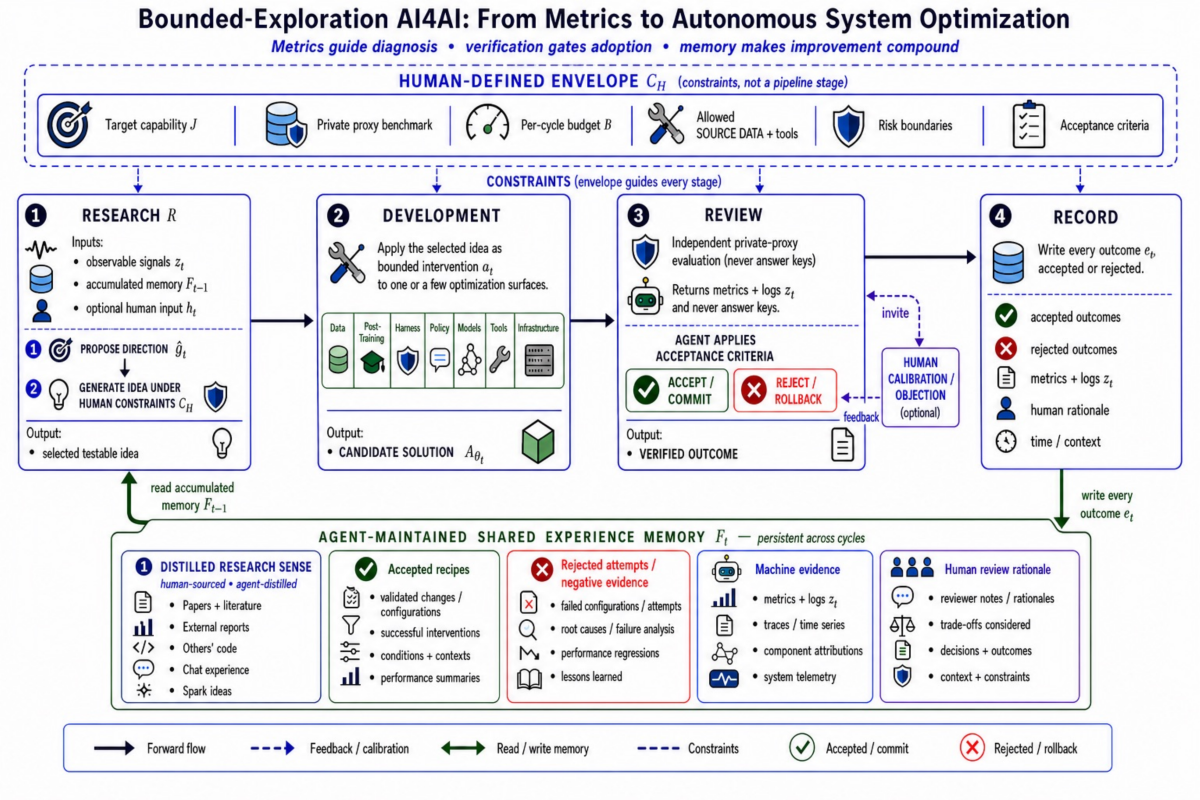
AI4AI at Scale: A Full-Pipeline System for Enhancing LLM Agentic Capabilities
XYZ Agentic Team
-
Abstract: This team report presents an agent-assisted development loop for deep search systems, spanning task construction, supervised post-training, runtime behavior, context management, and replay infrastructure. The released XYZ-Aquila systems are evaluated across seven search benchmarks. Reported scores describe the complete systems; they do not isolate the effect of an individual component or contributor.
-
Project: Technical blog and report.
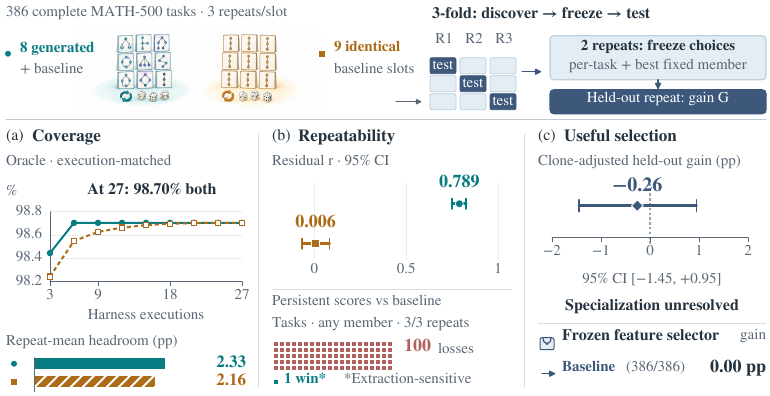
More Programs or More Rolls? Separating Coverage from Specialization in LLM Harnesses
Ziyang Xu, Haitian Zhong, Hao Zhou, Hao Qin, Chenhan Jin, Te Qi, Shengze Xu, Tieyong Zeng
- Abstract: Does generating different agent programs provide useful specialization beyond simply running the same program more often? We compare generated harnesses with repeated executions of identical baselines under matched inference budgets. The study separates answer coverage from repeatable task advantages and usable selection gains, showing why broader oracle coverage alone does not establish useful specialization.
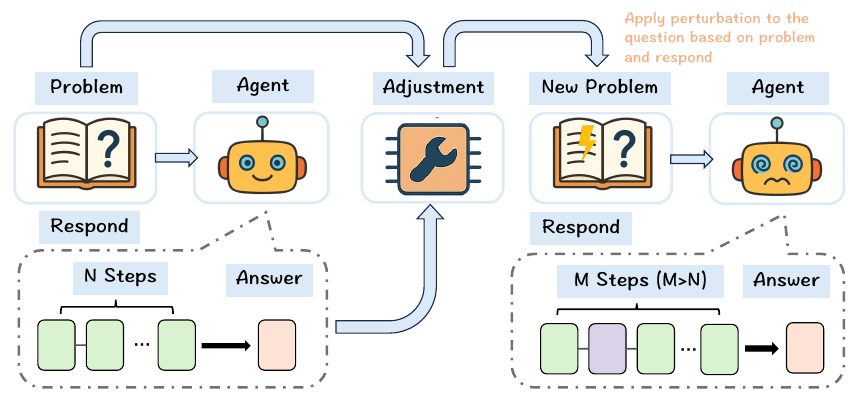
MorphoBench: A Benchmark with Difficulty Adaptive to Model Reasoning
Xukai Wang†, Xuanbo Liu†, Mingrui Chen†, Haitian Zhong†, Xuanlin Yang†, Bohan Zeng†, Jinbo Hu, Hao Liang, Junbo Niu, Xuchen Li, Ruitao Wu, Ruichuan An, Yang Shi, Liu Liu, Xu-Yao Zhang, Qiang Liu, Zhouchen Lin, Wentao Zhang, Bin Dong
-
Abstract: MorphoBench evaluates model reasoning with more than 1,300 multidisciplinary questions whose difficulty can evolve as models improve. It combines challenging source problems with reasoning-based question transformations and simulation-generated tasks. Adaptive difficulty and reasoning diagnostics help examine capabilities beyond performance on a fixed set of questions.
-
Codes and Data: GitHub.
Knowledge Editing
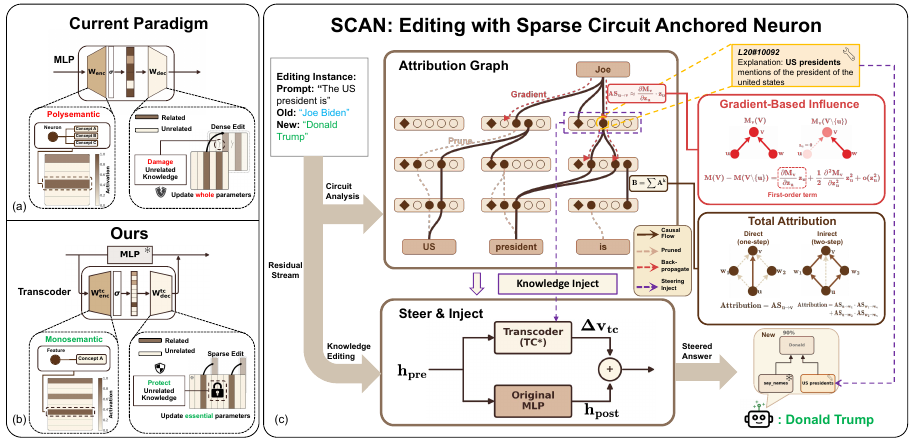
SCAN: Sparse Circuit Anchor Interpretable Neuron for Lifelong Knowledge Editing
Yuhuan Liu†, Haitian Zhong†, Xinyuan Xia, Qiang Liu, Shu Wu, Liang Wang
- Abstract: Repeated knowledge edits can disrupt previously stored facts and general model abilities. SCAN uses sparse transcoders and attribution graphs to locate fact-specific circuits and guide targeted editing. Experiments on multiple model families examine editing quality and retention of general capabilities, including MMLU and GSM8K, through sequences of up to 3,000 edits.

REACT: Representation Extraction And Controllable Tuning to Overcome Overfitting in LLM Knowledge Editing
Haitian Zhong, Yuhuan Liu, Ziyang Xu, Guofan Liu, Qiang Liu, Shu Wu, Zhe Zhao, Liang Wang, Tieniu Tan
- Abstract: Large language model editing methods frequently suffer from overfitting, wherein factual updates can propagate beyond their intended scope, overemphasizing the edited target even when it’s contextually inappropriate. To address this challenge, we introduce REACT (Representation Extraction And Controllable Tuning), a unified two-phase framework designed for precise and controllable knowledge editing. In the initial phase, we utilize tailored stimuli to extract latent factual representations and apply Principal Component Analysis with a simple learnable linear transformation to compute a directional “belief shift” vector for each instance. In the second phase, we apply controllable perturbations to hidden states using the obtained vector with a magnitude scalar, gated by a pre-trained classifier that permits edits only when contextually necessary. Relevant experiments on EVOKE benchmarks demonstrate that REACT significantly reduces overfitting across nearly all evaluation metrics, and experiments on COUNTERFACT and MQuAKE show that our method preserves balanced basic editing performance (reliability, locality, and generality) under diverse editing scenarios.

VLKEB: A Large Vision-Language Model Knowledge Editing Benchmark
Han Huang†, Haitian Zhong†, Tao Yu, Qiang Liu, Shu Wu, Liang Wang, Tieniu Tan
-
Abstract: Recently, knowledge editing on large language models (LLMs) has received considerable attention. Compared to this, editing Large Vision-Language Models (LVLMs) faces extra challenges from diverse data modalities and complicated model components, and data for LVLMs editing are limited. The existing LVLM editing benchmark, which comprises three metrics (Reliability, Locality, and Generality), falls short in the quality of synthesized evaluation images and cannot assess whether models apply edited knowledge in relevant content. Therefore, we employ more reliable data collection methods to construct a new Large Vision-Language Model Knowledge Editing Benchmark, VLKEB, and extend the Portability metric for more comprehensive evaluation. Leveraging a multi-modal knowledge graph, our image data are bound with knowledge entities. This can be further used to extract entity-related knowledge, which constitutes the base of editing data. We conduct experiments of different editing methods on five LVLMs, and thoroughly analyze how do they impact the models. The results reveal strengths and deficiencies of these methods and hopefully provide insights for future research.
-
Codes:
-
Dataset: Kaggle; huggingface.

🎖️ Honors and Awards
- 2024.06 🔥🔥Stars of Tomorrow Award (Award of Excellent Intern) as a member of Social Computing Group, Microsoft Research Asia.
- 2024.06 🔥🔥Undergraduate Graduate Representative of Lanzhou University, ranked 1/37 of all outstanding graduate nominees. News📰
- 2024.03 🔥Provincial Outstanding Graduates (2 out of 100 students in China’s Top-notch Undergraduate training program) Full List📜
- 2024.03 Outstanding Graduates of Lanzhou University Full List📜
- 2023.12 University Merit Scholarship, First Class (Top 1%) Full List📜
- 2023.04 The $14^{th}$ Chinese Mathematics Competition, Provincial First Prize (2nd place) Full List📜
- 2023.03 🔥The $13^{th}$ Chinese Mathematics Competition, National Second Prize Full List📜
- 2022.11 University Merit Scholarship, First Class (Top 1%) Full List📜
- 2022.07 🔥🔥2022 S.-T. Yau College Student Mathematics Contest (Analysis and Partial Differential Equations), Excellence Prize Full List📜
- 2022.07 🔥🔥2022 S.-T. Yau College Student Mathematics Contest (Applied and Computational Mathematics), Excellence Prize Full List📜
- 2022.05 National English Competition for College Students, National First Prize(Top 1%) Full List📜
- 2021.11 University Merit Scholarship, First Class (Top 1%) Full List📜
📖 Educations
- 2024.09 - 2029.06(Expected), Ph.D., NLPR, CASIA, Beijing, China. (Supervisor: Tieniu Tan; Co-supervisor: Qiang Liu)
- 2024.09 - Present, Joint Ph.D. student, Beijing Zhongguancun Academy, Beijing, China. (Supervisors: Bin Dong and Wentao Zhang)
- 2020.09 - 2024.06, B.S. in Mathematics and Applied Mathematics, Cuiying Honors College, Lanzhou University, Lanzhou, Gansu.
- 2014.09 - 2020.06, Nanjing Foreign Language School (NFLS
 ), Nanjing, Jiangsu.